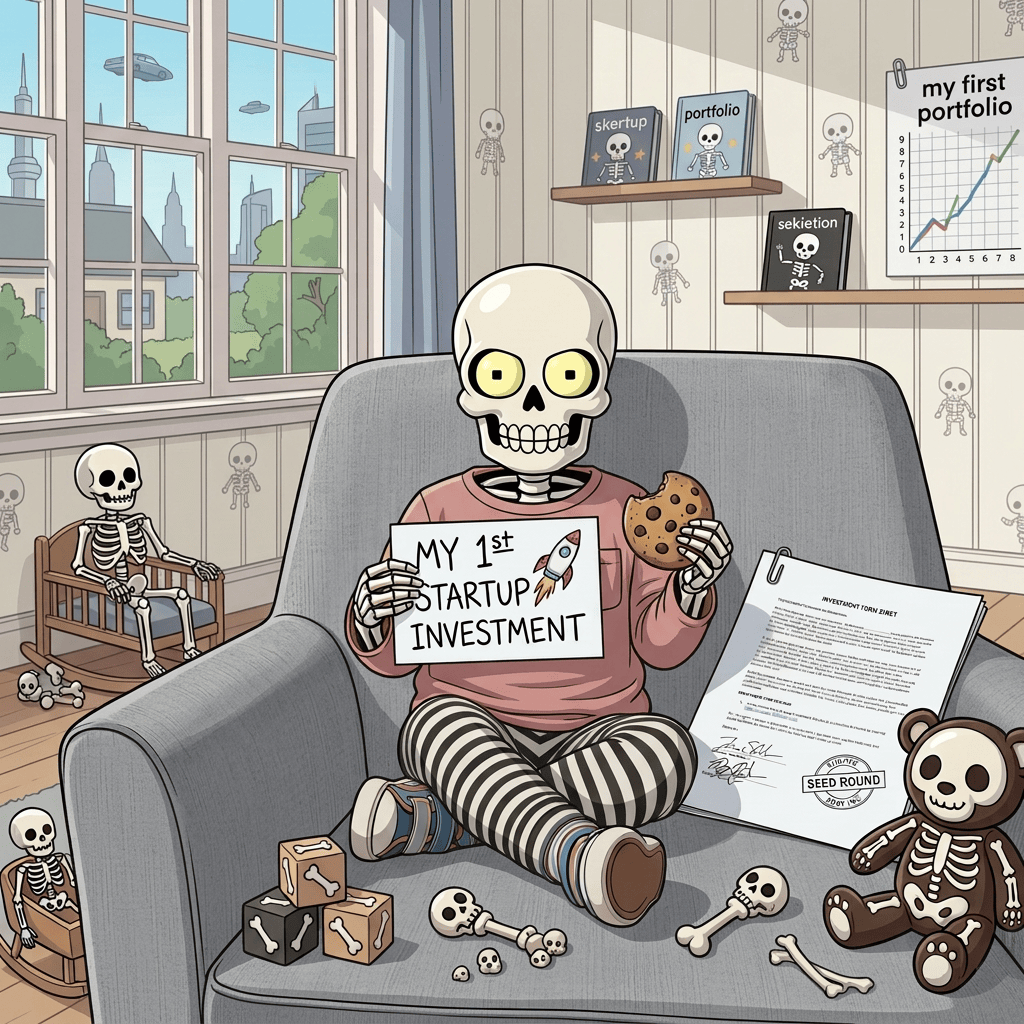
No business plan. No exit strategy. And a ROI you can’t put a fucking price on.
I’ve spent years helping businesses and founders navigate uncertainty, build strategies and plan for growth. You’d think some of that experience would come in handy when becoming a parent. Surely… Right?
// It does. Sort of...
Because having your first child is remarkably similar to launching your first startup. Except the stakes are higher, the operating hours are ridiculous and the person calling the shots can’t actually tell you what they want.
Before becoming a dad, I’d been an uncle, watched friends raise children and read enough parenting advice to think I had some idea of what was coming.
Turns out, knowing the theory and actually doing it are two very different things.
Much like starting a business, everyone has advice. Everyone knows what works. But until you’re the one making decisions at 3am, running on no sleep and questioning every decision you’ve made, you don’t really know what you’re in for.
And that’s where things get interesting.
BOOTSTRAPPING // FIGURING SHIT OUT.
The first year is pure startup mode. Limited resources, sleepless nights, constant experimentation, fucking about and a founding team trying to work out what the fuck they’re doing. You establish routines. They stop working. You think you’ve cracked something. Then your tiny co-founder decides to pivot the entire business model overnight.
But here’s where my strategist brain kicks in.
I’ve always believed strong foundations matter more than perfect plans. Whether you’re building a business or raising a child, what you put in early influences what comes later. The values you demonstrate. The environment you create. The behaviours you encourage. The confidence to explore, make mistakes and try again.
It’s essentially design thinking in action. Observe. Experiment. Learn. Adapt.
Progression over perfection.
Because not every milestone needs accelerating. Not every moment needs optimising. Sometimes you’ve just got to let a kid be a kid.
THE FUNDING ROUNDS // FROM ANGEL INVESTMENT TO SERIES B.
If we’re going to stretch the startup analogy, and I absolutely intend to, raising a child looks suspiciously like a series of funding rounds.
Let me elaborate:
PRE-SEED // PREGNANCY. The idea is real. The investment begins. You’ve done your research, bought a ridiculous amount of equipment and convinced yourself you’re prepared.
BOOTSTRAPPING // THE FIRST YEAR. Survival mode. No sleep, no established systems and a steep learning curve. Every small win feels enormous.
ANGEL INVESTMENT // TODDLERHOOD & CHILDCARE. Grandparents, family, friends and educators join the venture. Your support network expands, your child develops a personality and you discover that scaling requires letting go of some control.
SERIES A // PRIMARY SCHOOL. New environments, relationships and challenges. You’re building independence, confidence and resilience rather than managing every little decision.
SERIES B // HIGH SCHOOL. Now shit gets real. Leadership is challenged, strategic disagreements become commonplace and your role shifts from manager to mentor.
GROWTH STAGE // ADULTHOOD. Your little venture is becoming independent. Making decisions, taking risks and developing ambitions entirely their own.
And that’s the fucking point.
Unlike a traditional startup, success means making yourself progressively less necessary.
THE ROI // WHAT ARE WE ACTUALLY INVESTING IN?
In business, we obsess over return on investment. Time, money, resources, effort. What goes in versus what comes out.
But parenting doesn’t quite work like that.
You can invest everything you’ve got and still have absolutely no control over the outcome. Your child isn’t a product to optimise or a business to scale. They don’t owe you a return.
So perhaps the real ROI isn’t academic achievement, career success or how quickly they hit developmental milestones. Maybe it’s raising someone who’s curious, kind, confident, resilient and comfortable being themselves.
And perhaps the investment works both ways. Because for everything I’m trying to teach my daughter, Amélie, she’s teaching me just as much. Patience. Perspective. Adaptability. The importance of being present.
All things I thought I understood pretty well until I found myself negotiating with someone who considers putting on shoes a personal attack.
THE EXIT STRATEGY // KNOWING WHEN TO LET GO.
Here’s the irony…
We spend years investing everything into raising someone who, if we’ve done our job well, will eventually need us less. They’ll make their own decisions. Challenge our thinking. Make mistakes. Pursue opportunities we might not understand.
And we’ll have to learn when to offer advice and when to shut the fuck up.
As someone who makes a living helping people make better decisions, I suspect that’ll be my biggest challenge…
My daughter isn’t even two yet, so I’m hardly qualified to offer some grand theory on parenting. I’m still figuring it out myself.
But one thing I’m learning is that you can have a long-term vision without obsessing over every milestone. You can build strong foundations without controlling every outcome. And you can plan for the future without forgetting to enjoy what’s happening right in front of you.
Because childhood isn’t a project to deliver on time and within budget.
Sometimes the best strategy is to get on the floor, play the stupid game and enjoy the chaos.
Your first child might just be your first real startup. But the goal isn’t to build something you can eventually sell. It’s to raise someone who can eventually stand on their own.
And that’s a pretty extraordinary return on investment // return on effort.
—
PS: Clarity is easy to talk about and surprisingly difficult to create. If your team is currently navigating complexity, competing priorities or strategic drift, I’d be happy to have a chat.
💀🖤
Cheers,
DANIEL JACOBS
http://bjornfox.com
https://www.linkedin.com/in/denialjacobs/
Melbourne, Australia

