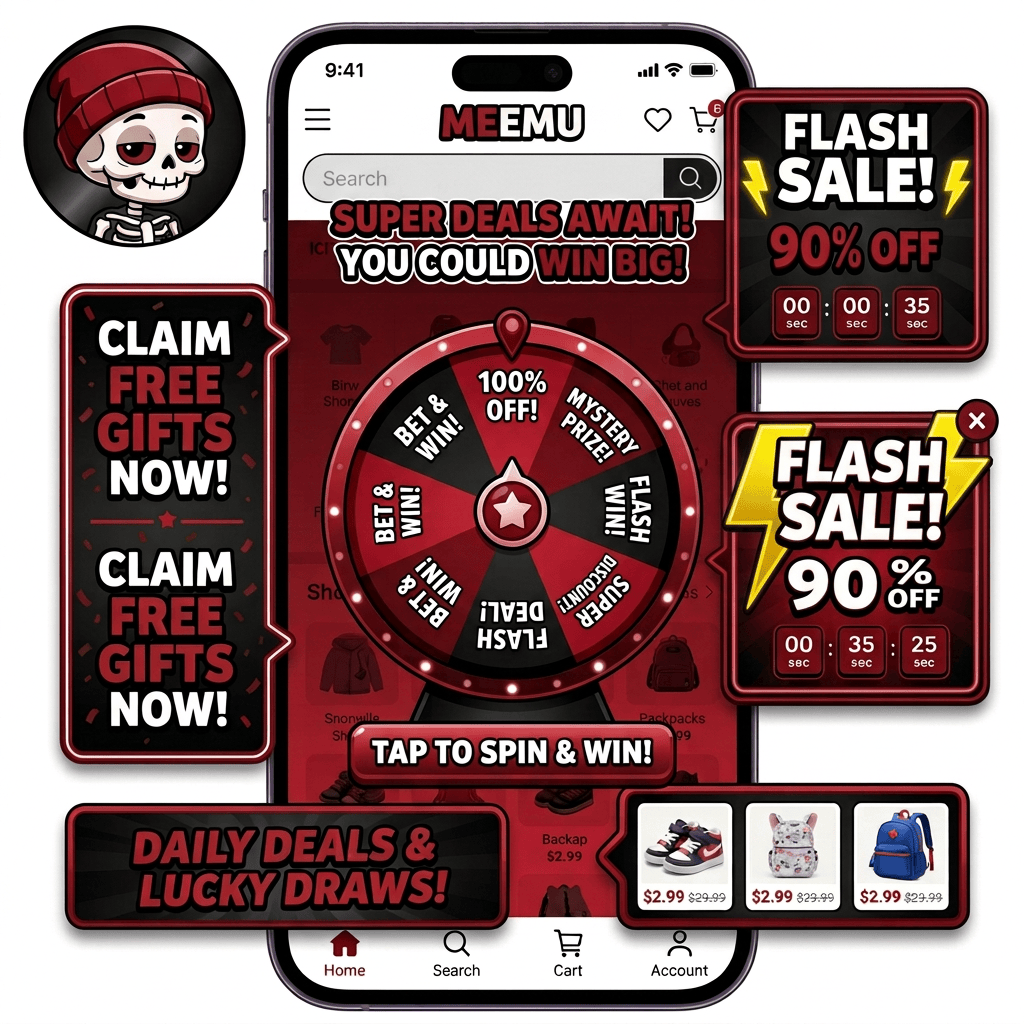
I was standing in Australia Post yesterday returning a couple of things purchased from Amazon (PS: shoutout to how easy and frictionless their return process is), chatting to the guy behind the counter about how ridiculously simple the whole process has become. Scan this. Drop that. Refund appears. Sometimes, depending on the product, they don’t even want the bloody thing back because the economics of shipping, processing, checking and restocking it probably make less sense than simply refunding you and moving on. We got onto the topic of Temu and I said something I’ve thought for a while… I still personally prefer Amazon. It’s clean. It’s familiar. It feels tested. I generally know where I am, what I’m doing and what is going to happen next. Temu, at least to me, feels like somebody put an e-Comm store, a pokies machine, a game show and a fucking pinball machine into a blender. Things flash. Things move. There’s urgency. There are prizes. There are wheels. There are deals on deals on deals. There’s always something else screaming at you to tap it, unlock it, claim it, win it or come back later. And maybe that’s the point. Because what if some ecommerce platforms aren’t really designed to help you buy something anymore? What if they’re designed to keep you playing?
THE INTERFACE ISN’T DECORATION
We talk about user experience as if it’s this lovely neutral discipline. Make things easy. Remove friction. Help people find what they need. Create delight. Lovely. But design is never neutral. Every interface is teaching you how to behave. Every button, notification, countdown, reward, animation, streak, badge, spin, surprise discount or “you almost won” moment is nudging you towards something. Sometimes that something is genuinely useful. Sometimes it’s getting you through a complicated process without wanting to throw your phone through a wall. But sometimes the objective isn’t ease at all. It’s frequency. Repetition. Time spent. Another tap. Another hit. Another chance. And once you start looking at some modern digital experiences through that lens, the gap between “gamification” and “gambling mechanics” starts getting a little fucking uncomfortable.
Pokies have understood this for decades. You don’t need someone to win constantly. In fact, constant winning would probably destroy the whole thing.
// What keeps people engaged is uncertainty.
Maybe this time. Nearly. Try again. Something flashes. Something makes a noise. Something celebrates you. Something tells you there’s another opportunity just around the corner. Online gambling simply took those mechanics and removed the need to physically walk into a casino. Now we’re taking similar behavioural ingredients and spreading them across ecommerce, gaming, loyalty programs, social media, dating apps, investing platforms, competitions and even charities. Spin this wheel. Open this box. Maintain this streak. Check in tomorrow. Buy now for another chance. Donate and you might win a house. Refer a friend and unlock another entry. It’s all technically different. But psychologically? Sometimes I’m not sure it’s as different as we’d like to pretend.
ARE WE TEACHING PEOPLE TO SHOP, OR TEACHING THEM TO PUNT?
This is the bit that really gets to me…
We have entire generations growing up inside interfaces designed around instant feedback, randomness, rewards, scarcity, streaks and repeated attempts. Gen Z. Gen Alpha. Tweens. Kids younger than that. They’re learning digital behaviour before they’ve even got a fucking bank account.
Tap something. Get something. Come back tomorrow. Get something.
Spin again. Try again. Buy again.
And I’m not suggesting that playing a game on an eComm app means a 12 year old is destined to walk into Crown Casino as soon as they hit 18 and blow their pay cheque on black jack or roulette.
// That would be ridiculous. Human behaviour isn’t that neat.
But I do think there’s a more interesting question underneath it:
What behaviours are we normalising?
The risk isn’t that we teach people gambling specifically. Maybe we teach them to become comfortable with the underlying rhythm of it.
Chance. Reward. Loss. Anticipation. Repeat.
That fucking matters.
“BUT IT’S FUN”
This is where it gets messy, because gamification isn’t inherently bad. Fun is good. Play is good. Surprise is good. Design that makes boring shit less boring is good.
A loyalty program that gives someone a little hit of progress can be great. A charity raffle can raise enormous amounts of money for something worthwhile. A brand can use games to create participation, entertainment and cultural relevance.
// The problem is that “engagement” has become one of those words we almost never interrogate hard enough.
We celebrate engagement because somebody stayed longer, clicked more, returned more frequently or completed another action.
Cool. But engaged doing what? And why?
There is a huge difference between someone willingly participating because the experience is entertaining and somebody being behaviourally engineered into a loop they’re finding increasingly difficult to leave.
// Yet commercially, both can produce a beautiful fucking engagement graph.
That’s the tension.
FRICTION ISN’T ALWAYS THE ENEMY
For years, UX has been obsessed with removing friction.
// One click. One tap. Buy now. Instant checkout.
// Instant credit. Instant access. Instant reward.
We’ve treated friction as if it’s always a design failure. But maybe some friction is useful. Maybe sometimes a good experience gives people enough space to make an actual decision.
Do I need this? Do I want this? Can I afford this?
Why the fuck am I doing this again?
Because when every action is immediate, exciting and rewarded, we’re not just designing convenience. We can start designing impulsivity… and that raises a much bigger responsibility for designers, marketers, product teams and businesses.
// Just because we CAN make somebody click doesn’t automatically mean we should.
WHERE THE FUCK IS THE LINE?
I don’t have a perfect answer TBH… And honestly, I don’t trust anyone who claims they do. The line will move depending on the audience, the product, the stakes, the mechanics and the intent.
But maybe, just maybe we should start asking better questions before we throw another wheel, streak, mystery box or artificial countdown into an experience because someone said “we need more engagement”.
Does this make the experience more useful? Does it make it more enjoyable?
Or does it simply make it harder to leave?
Are we rewarding participation, or manufacturing compulsion? Are we helping people make decisions, or deliberately shortening the distance between impulse and transaction?
And if a child spent 10 years interacting with experiences built around random rewards, endless loops, urgency and “one more try”, would we genuinely be comfortable saying none of that has any influence on the behaviours they carry into adulthood?
Who fucking knows… But I think it’s worth asking.
Because good UX shouldn’t just be about designing the shortest path to conversion. It should probably also be about understanding the kind of behaviour we’re creating along the way. So, maybe the question isn’t whether we can make people keep playing…
// Maybe it’s whether we should be designing everything like a fucking game in the first place.
—
PS: Clarity is easy to talk about and surprisingly difficult to create. If your team is currently navigating complexity, competing priorities or strategic drift, I’d be happy to have a chat.
💀🖤
Cheers,
DANIEL JACOBS
http://bjornfox.com
https://www.linkedin.com/in/denialjacobs/
Melbourne, Australia

