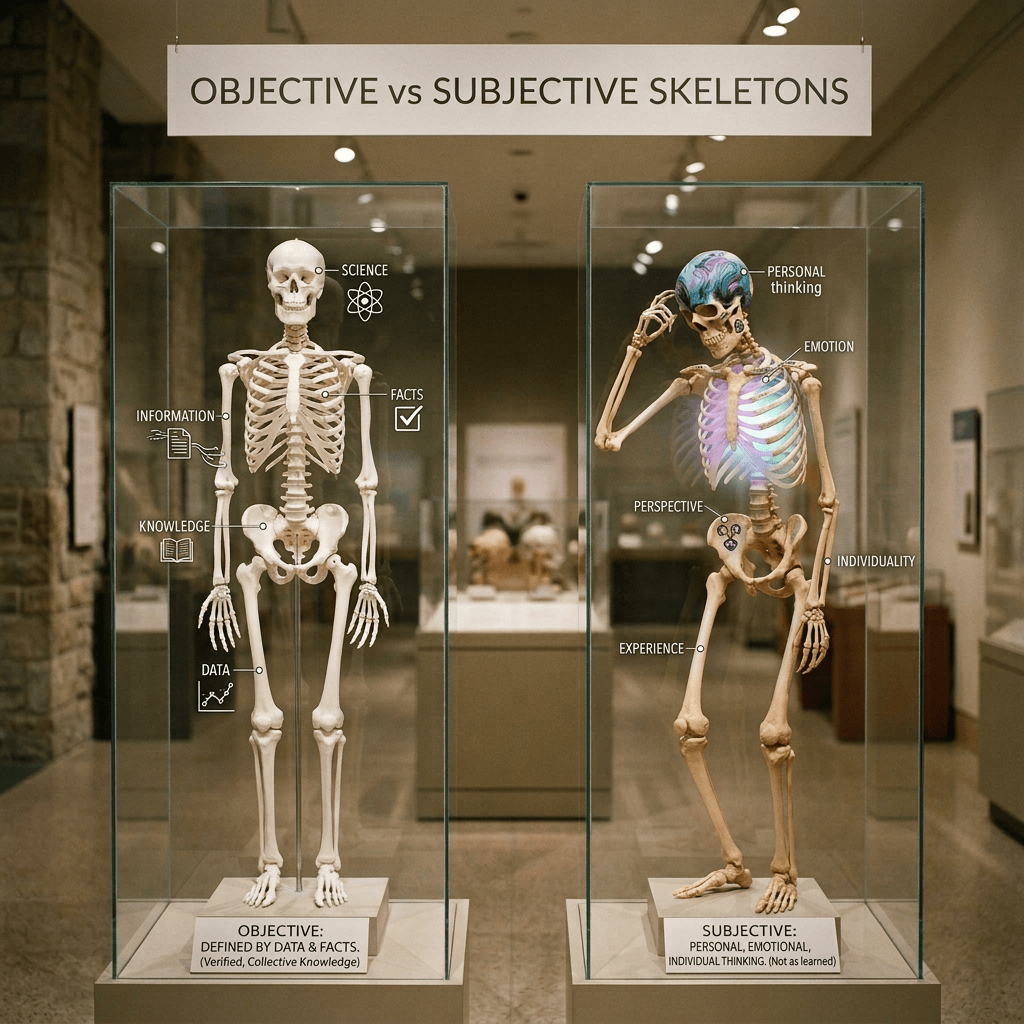
Everyone thinks they’re objective. Which is pretty fucking subjective when you think about it.
We like to believe our opinions are rational, our judgements are informed and our understanding of the world is reasonably accurate. But the reality is we’re all walking around with a lifetime of cultural conditioning, personal experiences, inherited beliefs, professional biases and a whole lot of things we’ve simply accepted as true because nobody ever gave us a compelling reason to question them.
And perhaps the most dangerous thing isn’t having an opinion. It’s having an incredibly confident opinion about something you know absolutely fuck all about.
// KNOWING SOMETHING ISN’T THE SAME AS UNDERSTANDING IT.
You can read about a culture without understanding it. Know the statistics behind a social issue without understanding the people experiencing it. Work in an industry for twenty years without understanding the customers keeping it alive. Or spend your entire life surrounded by people who think like you, then wonder why the rest of the world seems to have got everything so spectacularly wrong.
I’ve been fortunate to live and work across different countries, cultures, businesses and industries. And one of the most valuable things that’s taught me is how spectacularly limited my own perspective can be. Something that feels completely normal in one culture can seem utterly ridiculous in another. What motivates someone in one market might mean absolutely nothing to somebody elsewhere. And the moment you assume your own experience is representative of everyone else’s, you’re probably about to learn something the hard way.
The older I get, the more convinced I am that ignorance isn’t the problem. None of us knows everything. The problem is when we stop being curious enough to recognise what we don’t know.
// AN OPEN MIND REQUIRES THE POSSIBILITY THAT YOU’RE WRONG.
Being open-minded doesn’t mean agreeing with everyone, entertaining every ridiculous theory or pretending every opinion deserves equal weight. It means being willing to listen, investigate and understand before deciding what you believe. It means seeking information that might challenge your thinking rather than simply collecting evidence that makes you feel clever.
And occasionally, it means discovering that the thing you’ve been confidently banging on about for years is complete bollocks.
That’s not failure. That’s learning.
But if every unfamiliar perspective is dismissed, every contradiction is explained away and every conversation becomes an opportunity to defend what you already believe, you’re not really exploring anything. You’re just reinforcing the walls of your own little intellectual kingdom.
Congratulations. You’re the smartest person in a room you’ve deliberately made smaller.
// AND THEN THERE’S STRATEGY. OH, THE IRONY.
Strategists are supposed to be objective. It’s practically in the job description. We’re brought into businesses to challenge assumptions, provide an outside perspective, represent the voice of the customer and uncover the inconvenient truths that organisations might be too close to see.
Yet we’re just as capable of being full of shit as everyone else.
We’ve got our favourite frameworks, familiar methodologies, category experience, agency conditioning and preconceived ideas about how people behave. After enough years in the industry, it becomes dangerously easy to mistake recognising a problem for actually understanding it.
I’ve worked across consumer research, client-side marketing, agencies and consulting, and one thing I’ve noticed from every side of the table is just how quickly an assumption can become an accepted truth. Somebody says something confidently enough in a meeting, it gets repeated in a strategy deck, appears in a brief, survives three rounds of stakeholder feedback and suddenly everyone’s treating it like a fact.
“Our customers want convenience.”
“Gen Z demands authenticity.”
“Consumers are more purpose-driven than ever.”
“This category is all about price.”
Really?
HOW THE FUCK DO WE KNOW?
Did we ask? Did we observe? Did we investigate? Is there actual behavioural evidence? Or did somebody find a vaguely relevant statistic, stick it on a slide and call it an insight?
Because there’s a pretty substantial difference between what a business believes about its customers and what its customers actually think, feel and do.
And the customer doesn’t give a shit how convincing your PowerPoint looks.
// RESEARCH ISN’T THERE TO MAKE YOU RIGHT.
I started my career in consumer research, and one of the most useful lessons I took from it was that research is only valuable when it changes something. When it challenges a belief, exposes an opportunity, complicates an assumption or forces a business to reconsider what it thought it knew.
Research isn’t automatically objective either. You can ask the wrong questions, speak to the wrong people or interpret the right data in spectacularly convenient ways. I’ve seen plenty of research used to justify decisions that were clearly made long before anyone bothered speaking to a customer.
But good research gives reality an opportunity to disagree with us.
And that, to me, is one of the most important responsibilities of strategy.
Not to arrive with the cleverest answer. Not to prove the client wrong. Not to validate whatever creative idea everyone’s already fallen in love with. But to understand the problem well enough to recognise when our initial interpretation of it is complete rubbish.
Sometimes the most valuable thing a strategist can say isn’t “Here’s the answer.”
It’s “Are we even asking the right fucking question?”
// OBJECTIVITY ISN’T HAVING NO OPINION. IT’S EARNING ONE.
I don’t believe human beings can ever be completely objective. Our experiences, emotions, cultures and beliefs are always going to influence how we see the world. And frankly, that’s part of what makes us interesting.
But there’s a difference between having a perspective and being imprisoned by it.
Objectivity requires curiosity. Humility. The discipline to separate what we know from what we assume. The willingness to understand people whose lives look nothing like ours. And the intellectual honesty to change our minds when the evidence doesn’t support the story we’ve been telling ourselves.
That applies to the way we understand other cultures, navigate relationships, form opinions, lead businesses and develop strategy.
Because experience should make us better at asking questions, not simply more confident in our answers.
And perhaps that’s the real irony of getting older and supposedly becoming wiser. The more you genuinely learn about people, culture and human behaviour, the more you realise just how much there is left to understand.
So be curious. Challenge your own thinking. Get uncomfortable. Speak to people who see the world differently. Learn something that makes you question something you thought you knew.
And for fuck’s sake, don’t confuse having an opinion with having an understanding.
Subjectivity is human. Objectivity takes work.
// And the moment you think you’ve got nothing left to learn, you’ve probably got the most to learn.
—
PS: Clarity is easy to talk about and surprisingly difficult to create. If your team is currently navigating complexity, competing priorities or strategic drift, I’d be happy to have a chat.
💀🖤
Cheers,
DANIEL JACOBS
http://bjornfox.com
https://www.linkedin.com/in/denialjacobs/
Melbourne, Australia

