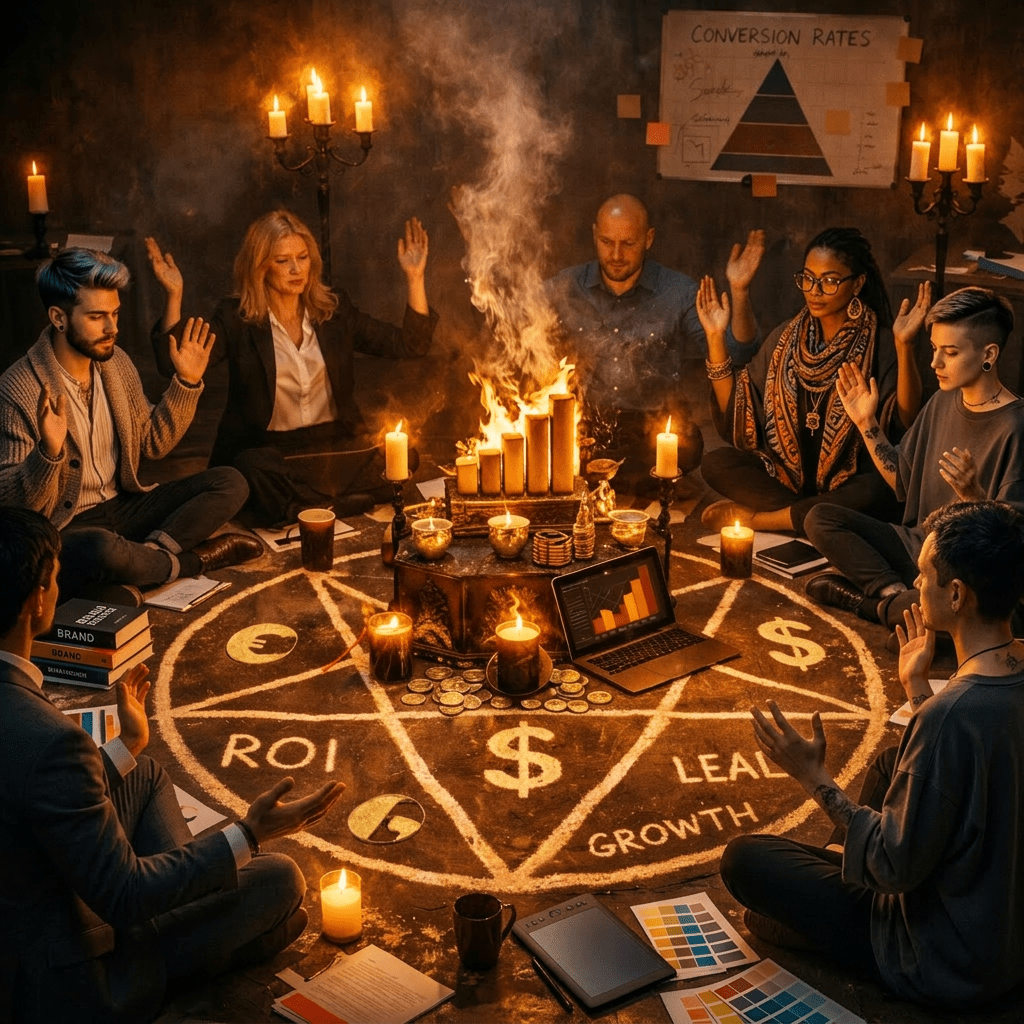
Lately, I’ve been thinking about how weirdly similar marketing and management consulting actually are…
Both industries pretend to be driven by logic, frameworks and commercial truth.
But underneath it all? They’re basically fandoms. Entire universes built around gods, disciples, sacred texts and belief systems.
In fact, the brilliant Zoe Scaman illustrates this sub-cultural ideology really well.
Read it here.
Marketing has its houses.
House Sharp.
House Campbell.
House Ogilvy.
House Bernbach.
House Kahneman.
House Godin.
House Binet.
Each one preaching their own version of truth about how growth actually happens.
One believes salience is king. Another believes emotional storytelling wins. Another believes distinctiveness matters most. Another thinks humanity is the moat. Another thinks behavioural science explains everything. Another thinks culture is the answer. Another thinks most marketers are just making expensive wallpaper.
And honestly? They’re all kinda right.
That’s what makes it interesting. But then I started wondering… Who are the gods of management consulting?
Because consultants have their own houses too.
House McKinsey.
House Porter.
House Drucker.
House Christensen.
House Bezos.
House Welch.
House Taleb.
Different language. Same energy.
One worships operational efficiency. Another competitive advantage. Another transformation. Another disruption. Another scale. Another shareholder value. Another anti-fragility. Again, all preaching their own version of commercial truth.
And then it hit me.
Every industry thinks THEY are the adults in the room.
Consultants think marketers are self-indulgent fluff merchants who confuse attention with business impact. Marketers think consultants optimise the humanity out of everything until every brand looks, feels and tastes the same.
Both are right. And both are wrong.
Because the problem isn’t creativity. And the problem isn’t optimisation.
The problem is ideological extremism.
When creativity loses accountability, you get self-congratulatory nonsense no normal human gives a shit about. Entire award ecosystems where the industry applauds itself while consumers barely even noticed the work existed. We fetishise shiny trinkets, case study theatre and Cannes-tinted mythology as proof of impact, when often the real world is far messier than the award submission suggests.
That’s not to say all awards are bullshit. Some genuinely celebrate effectiveness, commercial impact and strategic excellence. But even then, let’s be honest, the ability to write a compelling narrative often shapes perception just as much as the actual business outcome itself.
And on the other side?
When optimisation loses humanity, you get businesses slowly squeezing the soul out of themselves in pursuit of another 2.3% margin improvement while wondering why customers stopped caring.
One side worships awards.
The other worships efficiency.
Meanwhile the customer is standing there thinking: “Why does everything feel so fucking empty now?” That’s the bit I think both worlds miss.
Brands aren’t spreadsheets.
But they’re also not moodboards.
People don’t purely buy based on logic. But they also don’t buy based on beautifully kerned purpose statements and a fucking sonic DBA (distinctive brand asset).
The future probably belongs to the people who can sit in the uncomfortable middle. The translators. The ones who understand systems and soul. Behaviour and business. Creativity and consequence. Culture and commerciality.
The people who know growth isn’t just about squeezing harder or shouting louder.
It’s about knowing what should never be optimised away in the first place.
—
💀🖤
Cheers,
DANIEL JACOBS
http://bjornfox.com
https://www.linkedin.com/in/denialjacobs/
Melbourne, Australia

